Electric Oven Circuit Compatibility Calculator
Your Oven Specifications
Your Electrical System
Results
Enter your specifications to see compatibility results.
Note: New Zealand law requires licensed electricians for all fixed wiring installations. This tool provides guidance only and does not replace professional assessment.
Replacing an electric oven isn’t like swapping out a light bulb. Even if you’re handy with tools, you’re dealing with 240 volts-enough to kill you if you get it wrong. In New Zealand, the law doesn’t always force you to hire an electrician, but the risks and consequences of doing it yourself make it a bad idea for almost everyone.
Why Electric Ovens Are Different
Electric ovens don’t just plug into a regular outlet. They need a dedicated 240-volt circuit, usually with a 32-amp or 40-amp breaker. That’s the same kind of power used for air conditioners or electric stoves. The wiring is thicker, the connections are heavier, and the outlet (if there even is one) is a special isolating switch or hardwired terminal block.
Most homes built after 1990 have a dedicated circuit for the oven, often with a 15-amp or 32-amp isolator switch mounted near the appliance. Older homes might still have the oven wired directly into the fuse box without a switch. If you’re replacing an old oven with a new one, the wiring might not match up. New ovens often require a 10mm² cable, while older ones ran on 6mm². Getting that wrong means overheating, melted insulation, or worse-a fire.
The Law in New Zealand
Under the Electricity (Safety) Regulations 2010, any work involving fixed wiring-like connecting a new oven to the house’s electrical system-must be done by a licensed electrician. That includes running new circuits, changing the isolator switch, or rewiring the termination point.
You’re allowed to unplug and remove the old oven yourself. You can even move the new oven into place. But the moment you start touching wires, terminals, or the circuit breaker panel, you’re breaking the law. If you get caught, you could face fines up to $10,000. More importantly, if a fire starts because of your DIY job, your home insurance won’t pay out. Most policies require electrical work to be done by licensed professionals.
What Happens If You Skip the Electrician?
People think, “I changed a plug, I can handle this.” But ovens aren’t plugs. Here’s what can go wrong:
- Wrong circuit size: If the breaker is too small, it trips constantly. Too big, and it won’t protect the wires-leading to overheating.
- Loose terminals: A single loose live wire in the oven’s terminal block can arc, spark, and ignite surrounding insulation.
- Wrong cable type: Using flexible appliance cable instead of fixed wiring can cause overheating under constant load.
- Grounding issues: If the earth wire isn’t connected properly, a fault could electrify the oven’s metal casing.
In Dunedin, there have been at least three house fires since 2023 linked to DIY oven installations. All involved homeowners who thought they could save $300 by doing it themselves. Each fire cost over $50,000 in damage. One family lost everything.

What an Electrician Actually Does
A licensed electrician doesn’t just screw in wires. They:
- Check your existing circuit-amperage, cable size, breaker rating, and grounding.
- Verify the isolator switch is accessible and rated for the new oven’s load.
- Replace wiring if needed, using the correct 10mm² or 6mm² cable depending on the oven’s specs.
- Connect the oven’s terminals properly, torque them to manufacturer specs (usually 1.5-2.0 Nm).
- Test for earth continuity, insulation resistance, and polarity.
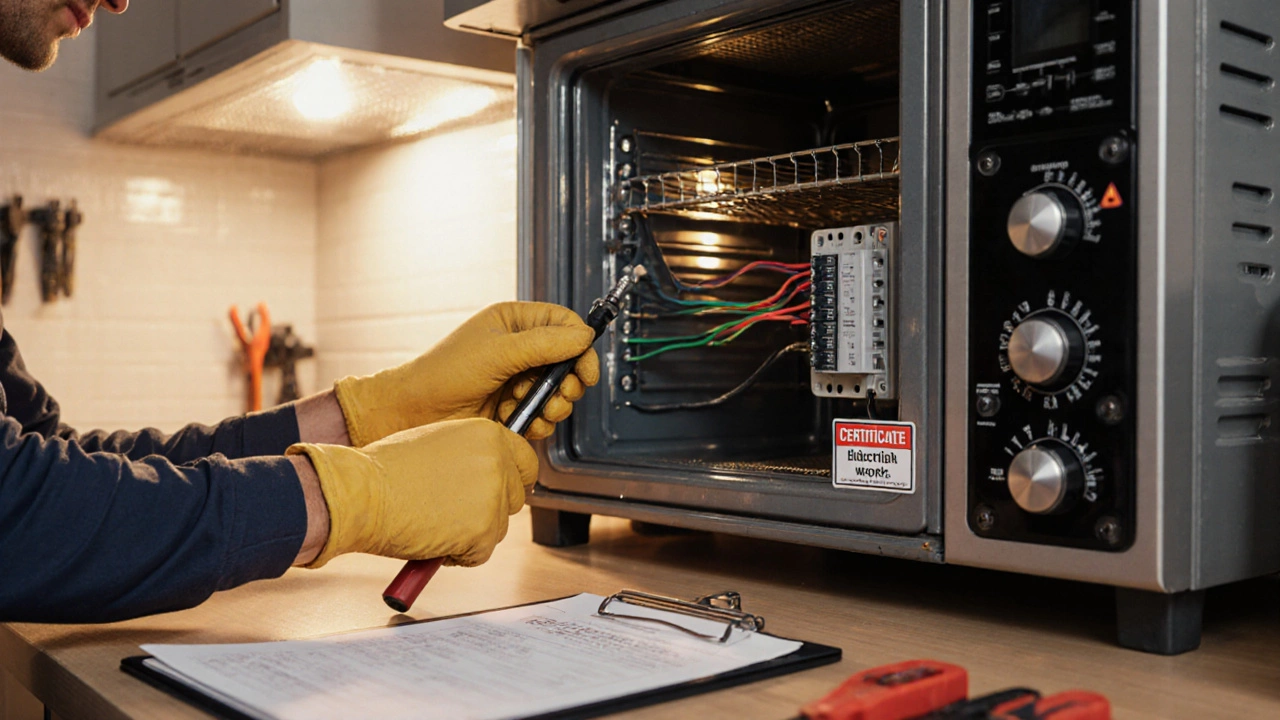
- Issue a Certificate of Electrical Work (CEW), which you need for insurance and future home sales.
That’s not a simple job. It takes 1.5 to 3 hours, depending on the condition of your wiring. Most electricians charge between $180 and $320 for this service in Dunedin. That’s a small price to pay compared to the cost of a house fire.
When You Might Not Need One
There’s one exception: if your new oven comes with a plug and your old one was plugged in. Some modern compact ovens or built-in models now come with a standard 10-amp plug. But even then:
- The outlet must be on a dedicated circuit-not shared with other appliances.
- The circuit must be protected by a 10-amp or 16-amp breaker, not a 32-amp one.
- You still need to check if the outlet is rated for continuous high-load use.
Most full-sized electric ovens don’t come with plugs. They’re hardwired for safety and performance. If you’re unsure, check the installation manual. If it says “hardwired” or “must be connected by a licensed electrician,” don’t ignore it.

How to Find a Good Electrician
Look for an electrician with an Electrical Worker’s Licence (EWL) and a current Practicing Certificate from the Electrical Workers Registration Board (EWRB). You can verify their license at ewrb.govt.nz (though you can’t link it, just know it exists).
Ask for:
- Proof of current licensing
- Experience with oven installations
- A written quote that includes the CEW
- Guarantee on the work
Don’t go with the cheapest bid. Cheap electricians cut corners. They might skip testing, use undersized cable, or skip the CEW. That’s not saving money-it’s gambling with your home.
What to Do Before the Electrician Arrives
Make the job smoother:
- Turn off the power at the main switch before removing the old oven.
- Take a photo of the wiring behind the old oven before disconnecting anything.
- Clear the area around the oven-move cabinets, rugs, or clutter.
- Have the new oven’s manual ready. The electrician will need the voltage, amperage, and cable size.
Don’t try to rewire or label wires yourself. That often makes things worse. Just leave it to the pro.
Final Thought: It’s Not About Skill-It’s About Risk
You might be the kind of person who fixes bikes, changes car brakes, or rebuilds computers. That’s great. But electricity doesn’t care how good you are. One slip, one miswired terminal, one overlooked ground, and it’s over.
Replacing an electric oven isn’t a DIY project. It’s a safety-critical task that requires training, certification, and legal compliance. Paying a licensed electrician isn’t an expense-it’s insurance. For your life, your home, and your family’s future.
When you turn the oven on for the first time after the install, you’ll want to feel safe-not anxious. That peace of mind? That’s worth every dollar.
Can I replace my electric oven myself if I turn off the power?
Turning off the power doesn’t make it legal or safe. Even with the power off, you’re still required by New Zealand law to have a licensed electrician connect the new oven to the fixed wiring. You can remove the old unit yourself, but connecting the new one involves modifying the home’s electrical system-which only a licensed electrician can do.
What happens if I install the oven myself and get caught?
You could be fined up to $10,000 under the Electricity (Safety) Regulations 2010. More seriously, if a fire or injury occurs because of your installation, your home insurance will likely deny your claim. You’d be personally liable for all damages, medical costs, and legal fees.
Do all electric ovens need a dedicated circuit?
Yes. Standard electric ovens require a dedicated 240-volt circuit with its own breaker-usually 32 or 40 amps. Sharing the circuit with other appliances like a dishwasher or kettle can overload the system, trip breakers, or cause overheating. Always check the oven’s manual for exact circuit requirements.
How much does it cost to have an electrician replace my oven?
In Dunedin, expect to pay between $180 and $320 for the installation, depending on complexity. This includes disconnecting the old oven, checking wiring, installing the new one, testing for safety, and providing a Certificate of Electrical Work. Most jobs take 1.5 to 3 hours.
Can I use a plug-in oven to avoid hiring an electrician?
Only if the oven is specifically designed as a plug-in model and your existing outlet is on a dedicated circuit rated for its load. Most full-sized electric ovens are hardwired for safety and performance. Even plug-in models require a dedicated circuit and proper outlet rating. If you’re unsure, don’t guess-call an electrician.
Why do electricians need to issue a Certificate of Electrical Work?
The Certificate of Electrical Work (CEW) proves the installation meets New Zealand’s safety standards. It’s required by law for fixed wiring work. Without it, your home insurance may be invalid, and you won’t be able to legally sell your home. It also protects you if something goes wrong later.